PUBLISHED · GUIDE 8 OF 18
Record what the reverse actually shows
This photographed Season 1 Omni-Man card has no documented opening box or verified first-print status. Both sides are needed for a later print-batch comparison.
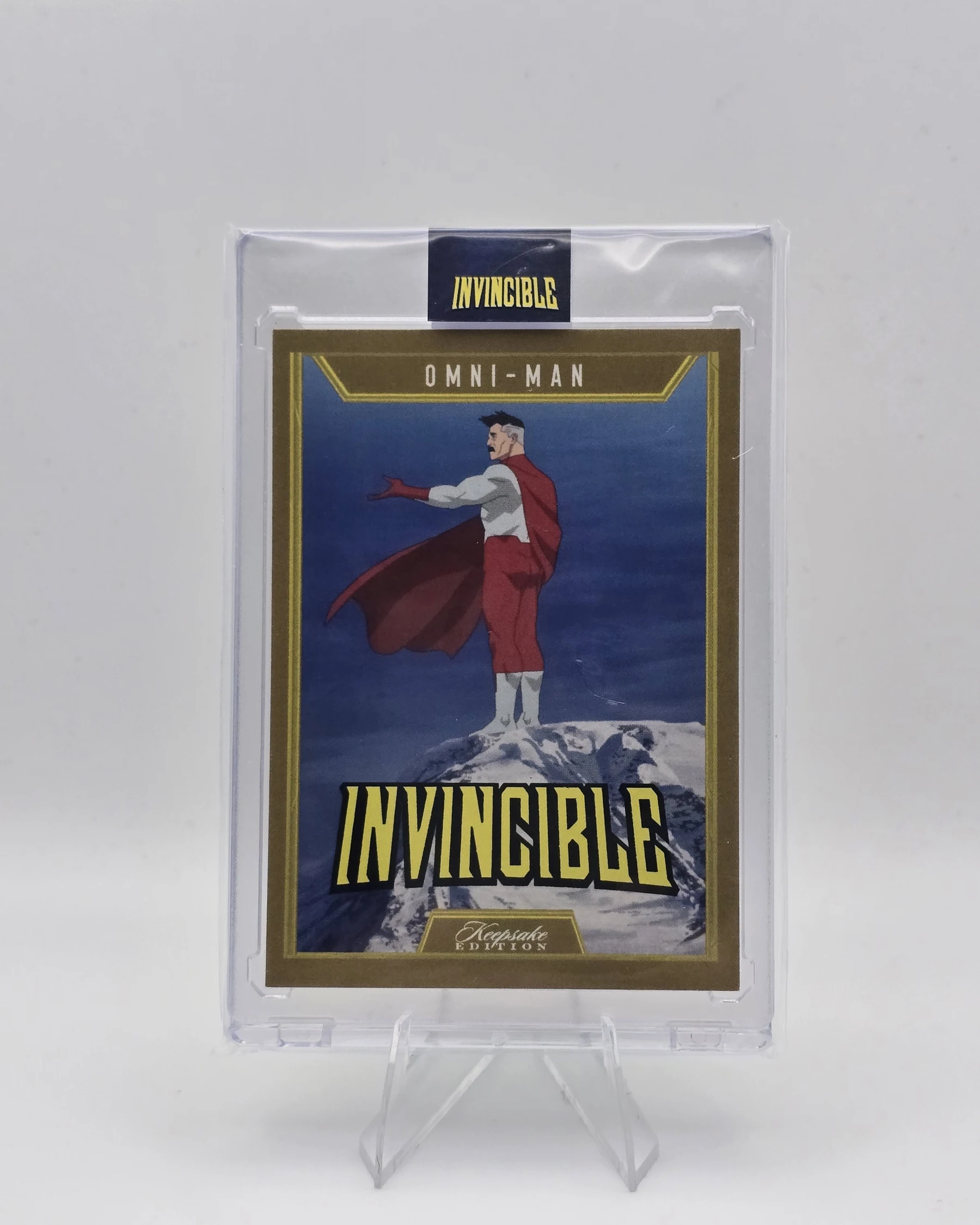
Front: keep the complete object, border and original background visible.
Examine this item ↗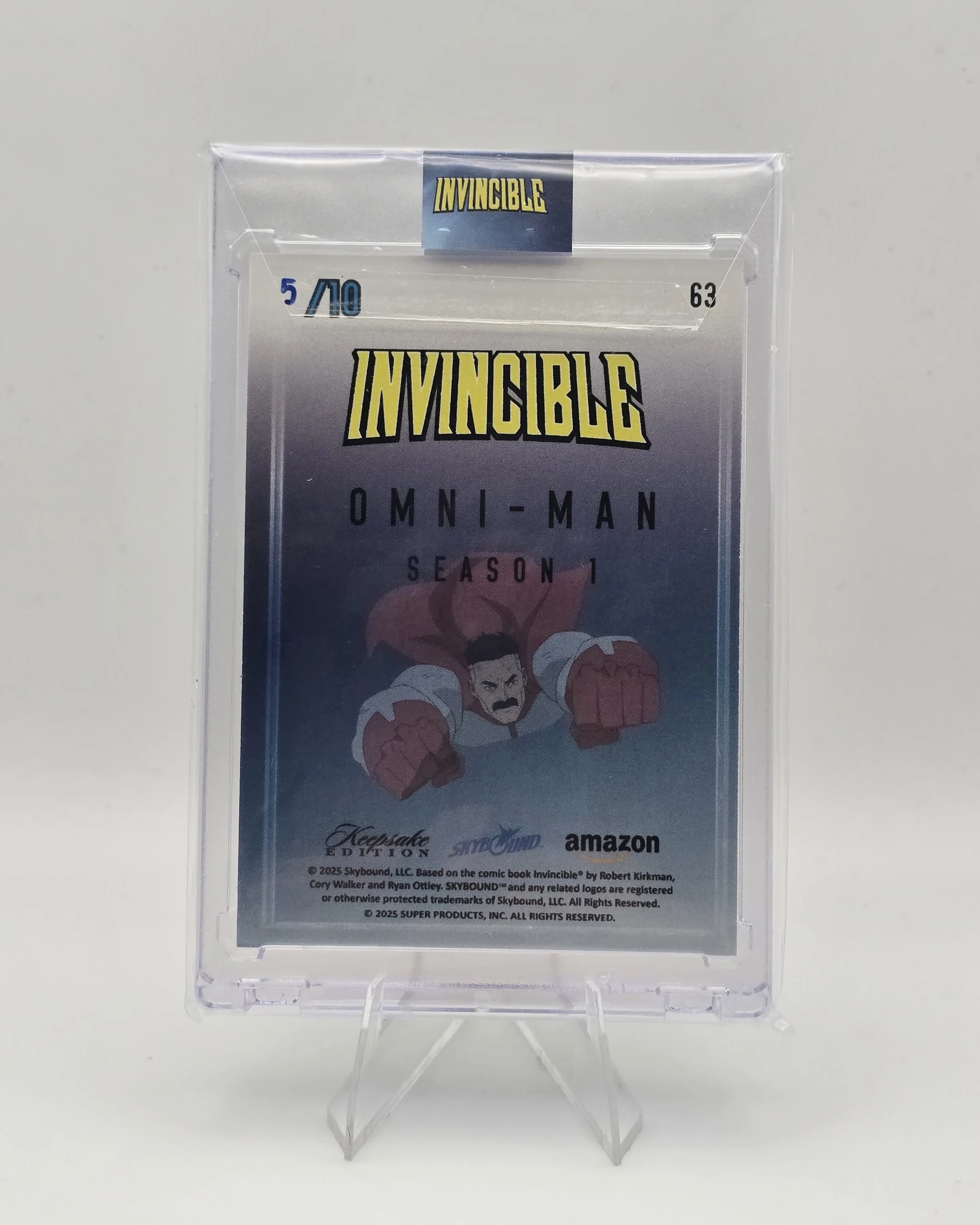
Reverse: record card #63, serial 5/10, logos and copyright; none alone dates this copy's print batch.
Examine this item ↗Four different claims that sound like first print
A seller can say 'first release,' '1st Edition,' 'first print' or '01/10' while pointing to four different facts. Set the question before looking at the card. Keepsake calls its Season 1 Premiere product the first officially licensed trading-card release for the animated Invincible series, with a July 24, 2025 release date on the Hobby page. That establishes product chronology. It does not identify the production batch of a particular loose card.
The words '1st Edition Debut Premiere' are part of Keepsake's product description. A later purchase of a product carrying that language does not automatically become a documented opening-day print. Likewise, a serial stamp of 01/10 means copy one in the stated ten-copy version; the number is not a production date. Record each claim in its own field so the evidence for one cannot be mistaken for proof of another.
| Claim | Evidence to ask for | What it does not prove |
|---|---|---|
| First licensed release | Keepsake's dated Season 1 Premiere product information | Which batch an individual card came from |
| 1st Edition wording | Exact product or card wording and matching checklist | That the copy was made in the earliest batch |
| First physical print batch | Documented early provenance and a verified, like-for-like print comparison | A conclusion from one logo photo alone |
| 01/10 serial | Clear image of the stamp on the exact card | First printing or first card manufactured |
Start with the manufacturer release, not the listing title
Keepsake's Season 1 Premiere Hobby page says 'Release - July 24th, 2025,' describes the first officially licensed cards for the television series, and links its official checklist and pack odds. The Hobby format is described as sixteen four-card packs and two relics per box. Premiere also has a Blaster format. This is the appropriate starting point when somebody means the first Keepsake Invincible release.
Season 1 Holo, Battle Beast Spotlight, Season 2 Premiere and Invincible VS are separate product families. Holo can picture the same character and carry a 2025 copyright without becoming a Season 1 Premiere card. Even a phrase containing '1st Edition' can appear in a later release's named chase-card description. Use the manufacturer's page for the exact family, then the checklist for that card's number and insert category. Do not treat a personal archive as a complete manufacturer checklist.
| Question | Where to look | Record |
|---|---|---|
| Which family? | Exact box name, card design and manufacturer checklist | Premiere, Holo, Spotlight, Season 2 or VS |
| Which format? | Sealed box wording or documented opening | Hobby, Blaster, Breaker or unknown |
| Which card? | Full front and reverse with card number or insert name | Checklist entry and parallel |
| Which batch? | Original purchase/opening evidence plus comparable card photographs | Documented, consistent or unverified |
Photograph the complete card before comparing print details
For a loose card, take one straight-on image of the entire front and one of the entire reverse. Keep all four card edges and some of the original photo background in both images. Add separate, sharp close views of the copyright line, Keepsake and Amazon marks, card number, serial stamp and any special finish. The close views help with typography; the full views show that the details belong to the same physical copy and let you assess the border and condition.
The photographed Omni-Man card in this guide is a Season 1 card with no documented opening box or verified first print status. Its reverse is useful for locating the card number, serial mark and logos, but none alone proves the particular box format or print batch. For a first-batch claim, obtain the same checklist entry and variant from an independently documented early source before judging differences between two images.
- Save the untouched full-resolution files and the seller's original listing images.
- Photograph the reverse flat and in focus; glare and perspective can change the apparent letter shape.
- Write down exactly which physical copy each front and reverse shows.
Treat reported logo differences as clues, not a certificate
Collectors have discussed a narrower or taller lowercase 'o' in the Amazon logo on some card backs, a white rather than dark Keepsake mark on some low-numbered cards, and differences in how serial numbers look. These are collector-reported observations, not a manufacturer-published first-print authentication standard that we could verify. The marks may also differ across inserts, treatments or product families. A single photograph of one copy cannot establish the direction of a variation.
If you investigate those clues, compare the same card number and the same parallel in two well-documented copies. Photograph both at similar resolution and angle, then record the precise visible difference and where the provenance for each came from. Do not label all cards with a narrow 'o' first print or every white logo an original batch on the strength of a generalized online example. Leave the batch field unverified until the comparison and source are sound.
| Possible clue | Compare only after | Status |
|---|---|---|
| Amazon-logo lowercase 'o' | Same release, card design and variant; sharp reverse scans | Unconfirmed as a universal batch rule |
| Keepsake-mark colour | Same checklist subset and surface treatment | Unconfirmed as a universal batch rule |
| Serial-stamp appearance | Same version under similar light and image quality | Unconfirmed as a universal batch rule |
Build a comparison that another collector can repeat
Start with an exact identity line: '2025 Season 1 Premiere, [checklist number and title], [parallel], [serial if present].' Locate a candidate from an opening documented near the initial release and a comparison copy of that same identity. Keep the date of the original listing or opening, the box format if known, and the unedited front and back files. A dated receipt for a box establishes when that box was purchased, but it still needs a credible connection to the exact card pulled from it.
Then compare typography and logos at the same scale. Note differences without immediately assigning an older side. Packaging revisions, print variation, camera sharpening, compression and lighting can all imitate a meaningful change. If the card designs or serial treatments differ, stop and classify those differences before discussing print order. The strongest conclusion may be 'two observed back variants, order unconfirmed.' That is more useful than a confident label built from an unmatched card.
- Match release, checklist entry and parallel before examining tiny marks.
- Keep complete front/back photos, then optional close views, for each copy.
- Attach dated opening or purchase evidence to the exact copy when possible.
- Log the observed variant separately from the inferred print-batch claim.
Assign a confidence level and track the evidence
A collection record should preserve what you know and what you still need. Use a status such as documented, consistent with an early-batch hypothesis, or unverified. 'Documented' should require independently dated origin evidence tied to the actual card, plus a reliable way to distinguish that batch. 'Consistent' means some visible clues align with a properly matched reference but the chain of evidence is incomplete. 'Unverified' means you have only a title, year, stamp or isolated logo photo.
Your sheet can hold separate columns for release family, format if known, card number, name, insert, parallel, serial numerator and denominator, the card's front and back originals, details observed on the reverse, purchase or opening date, evidence link, comparison specimen and confidence. Keep a notes field for unresolved differences. If a seller changes the classification later, the original photos and notes will show why the record was updated.
| Field | Example entry | Why it matters |
|---|---|---|
| Card identity | Season 1 Premiere · exact checklist entry · parallel version | Prevents a cross-set comparison |
| Serial | 05/10 (if printed) | Identifies a copy, not its production date |
| Photos | Full front, full back, optional close views | Preserves edges and small print together |
| Provenance | Dated opening tied to this copy, or unknown | Separates observed origin from a seller claim |
| Batch status | Documented / consistent / unverified | Prevents certainty from outrunning evidence |
Questions to ask before paying a first-print premium
Ask the seller for the exact release, checklist number, variant and the reason they call this copy first print. Request the original, uncropped front and reverse photographs and any dated opening evidence. If a logo detail is their entire case, ask for the same card and variant from the documented early comparison group and the source of that group. A grading holder or a serial 01/10 may support identity and condition, but neither automatically documents physical print order.
A 2025 copyright, a black border, a 1/1 stamp or the word 'Original' in a card title also cannot date a physical print batch by itself. Keepsake advertises Black Gold and other 1/1 designs within Premiere, but a parallel's existence is a checklist fact, not a manufacturing date for a particular copy. If a label or seller claims 'first print,' ask what the term means and what evidence ties that claim to the actual card.
Price the card you can verify: its exact design, serial tier, condition and the evidence included with it. If print-batch status is central to the premium and remains unresolved, describe it as unverified in your records and negotiate on that basis. Keep the seller's claim and the photos together. This process helps a future buyer review the same evidence, even if the community's understanding of print differences improves.
- Can you show the complete original front and reverse of the exact card?
- Which manufacturer checklist entry and product family is it?
- What dated evidence ties this specific card to the claimed early batch?
- Is the comparison against the same card and parallel, and can I see both originals?
Sources and evidence notes
Keepsake's pages establish the product release and checklist. The collector comparison is a reported observation, not a manufacturer authentication rule for an individual card.
- Keepsake: Season 1 Premiere Hobby, July 24, 2025 release and official checklist link ↗
- Keepsake: Season 1 Premiere Blaster product family ↗
- Keepsake: separate Season 1 Holo Hobby release ↗
- Keepsake-linked Season 1 Premiere Hobby checklist ↗
- Collector comparison of reported logo and numbering clues (unverified by Keepsake) ↗