PUBLISHED · GUIDE 5 OF 18
Read the front and reverse
This Denver SignaGraph is one photographed 4/10 copy. Its serial applies to this named card version, not every Invincible card.
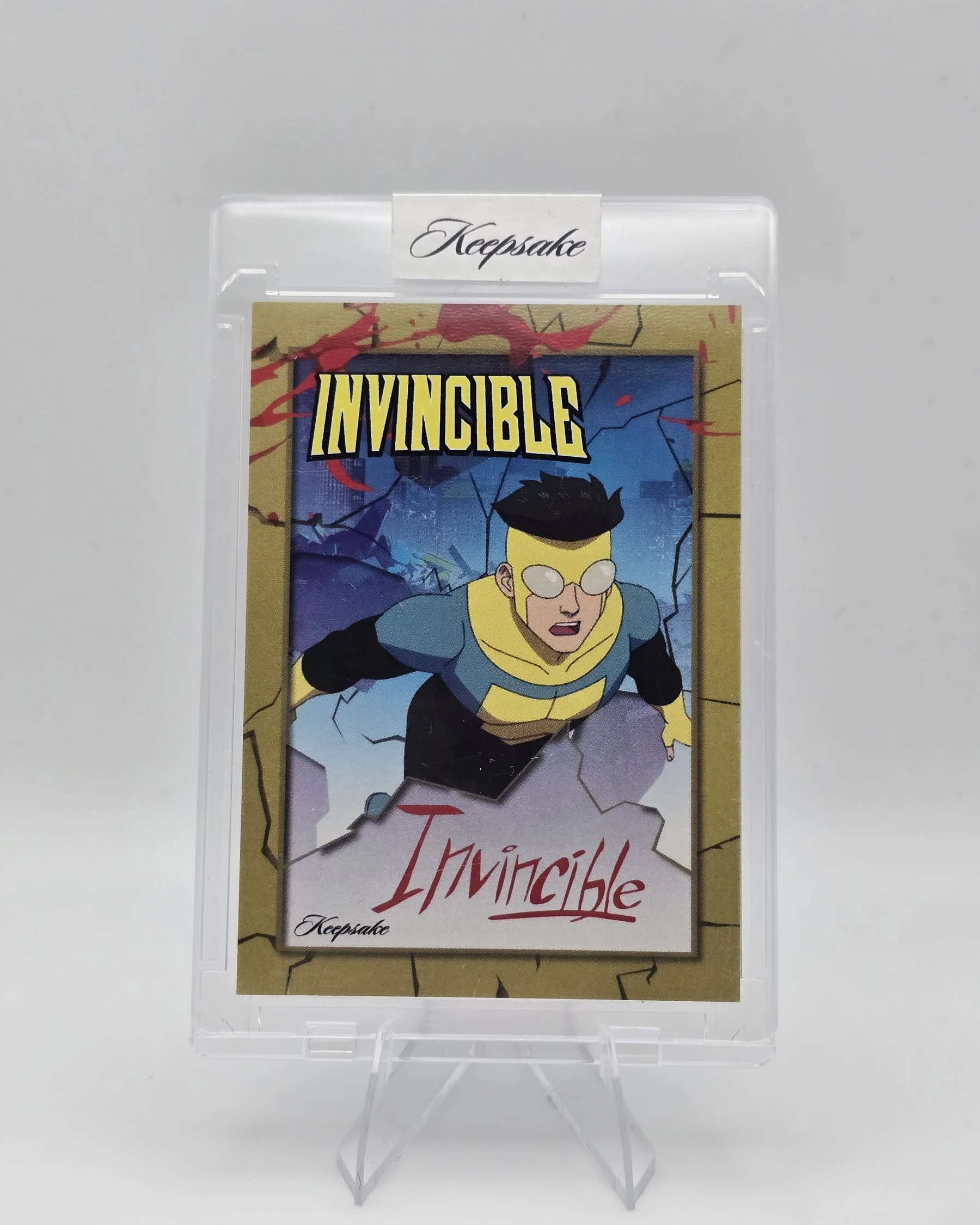
Front: identify the design and treatment.
Examine this item ↗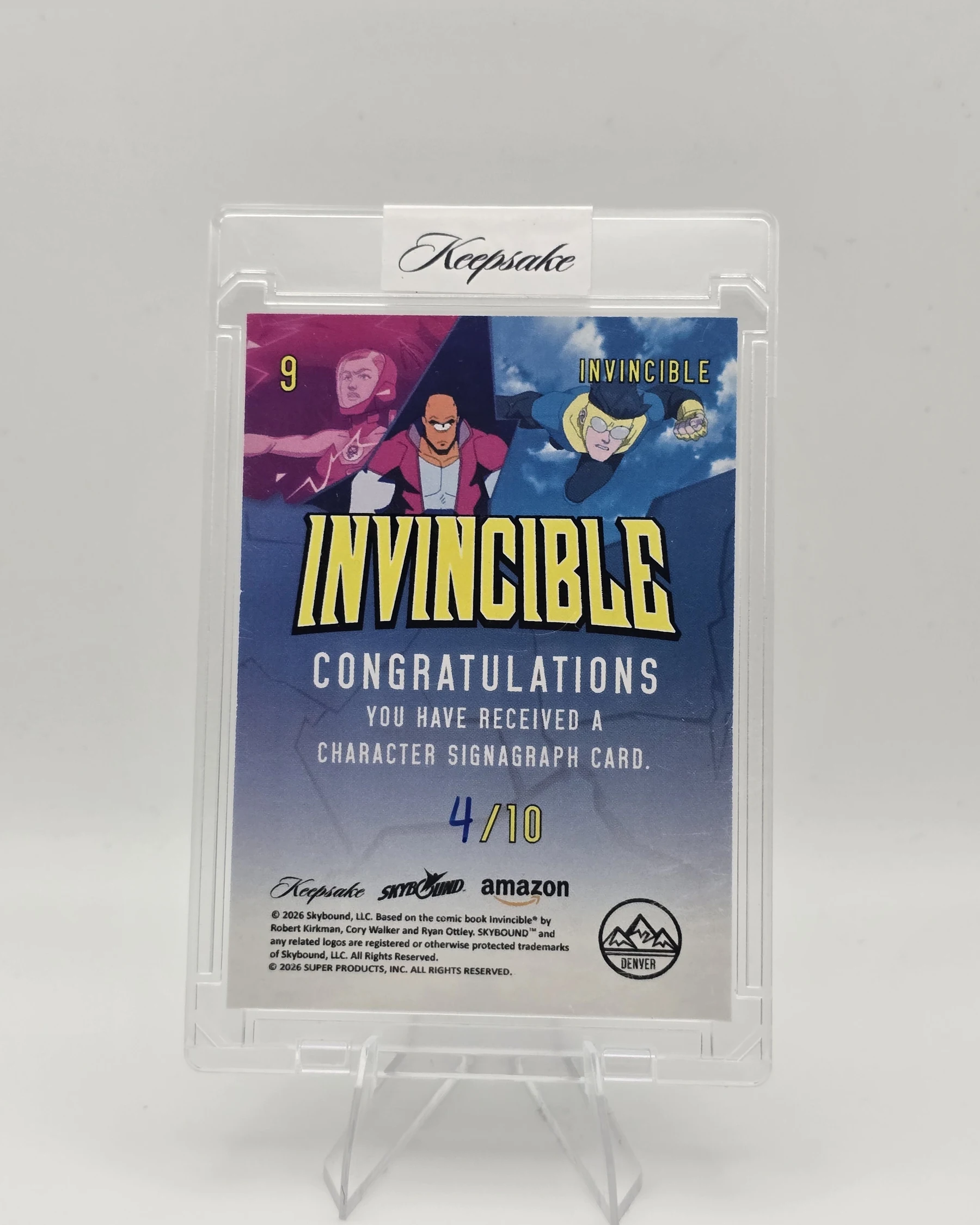
Reverse: check the printed card details.
Examine this item ↗First separate a checklist number from a serial stamp
A checklist number identifies a card design's position within a particular release. The Season 2 Premiere Breaker description, for instance, places base cards at 1–150 and SignaGraphs at 310–449. Those are category ranges in a checklist. A serial stamp such as 03/20 has a different job: it identifies the pictured physical copy as the third of a stated twenty-copy run of that version. If a listing says 'card 310 /20', the two numbers can coexist without contradiction.
The denominator does not count all cards featuring that character. A 03/20 Atom Eve card does not establish that only twenty Atom Eve cards exist across every design and set. Look for the complete set name, checklist position, variant and serial stamp together. When an image hides the card's reverse or stamp, ask for another photo instead of guessing whether the number in a listing title is a checklist position or a print-run denominator.
Keep type, subset, parallel and serial in separate fields
A card can have all four attributes at once. The type tells you the card family or construction: a Power Gem Stone insert, an Authentic Dual Relic, a Laser SignaGraph, or a SignaPatch. A subset is a named group inside the checklist, such as Kill Splatter. A parallel is a version of an underlying design, such as a specifically documented Gold treatment. The serial stamp records the copy and its edition cap. None of those words alone proves which sealed box held the photographed card.
The Season 1 Premiere checklist identifies Battle Beast #299 in its gemstone group, Robot and Atom Eve #523 in its dual-relic group, the four-character #436 as a Quad Laser SignaGraph, and Dupli-Kate vs The Flaxans #289 as Kill Splatter. The photographed backs corroborate their numbers and subjects; the checklist supplies exact subset labels that a reverse may not print. Neither source alone establishes the opening box. Battle Beast Spotlight's SignaPatch is a different release and relic category. Read any material claim on the card itself before specifying what a relic contains.
| Field | What it answers | Photographed or manufacturer example |
|---|---|---|
| Release / checklist | Which product family and numbered list? | 2025 Invincible Season 1 #299; Battle Beast Spotlight uses its own list |
| Type / insert | What kind of card is it? | #299 Power Gem Stone; #523 Authentic Dual Relic; #436 Quad Laser SignaGraph |
| Subset | Which named design group? | #289 Dupli-Kate vs The Flaxans: Kill Splatter on the Season 1 checklist |
| Parallel / finish | Which verified version of that design? | A documented Gold treatment; color in a photograph alone is insufficient |
| Serial stamp | Which physical copy and edition cap? | 10/10 on the photographed #289; the /10 does not name its color |
Four photographed checklist families
Compare the card number and reverse with the manufacturer checklist before interpreting a parallel or serial stamp. The loose card does not establish its opening box.
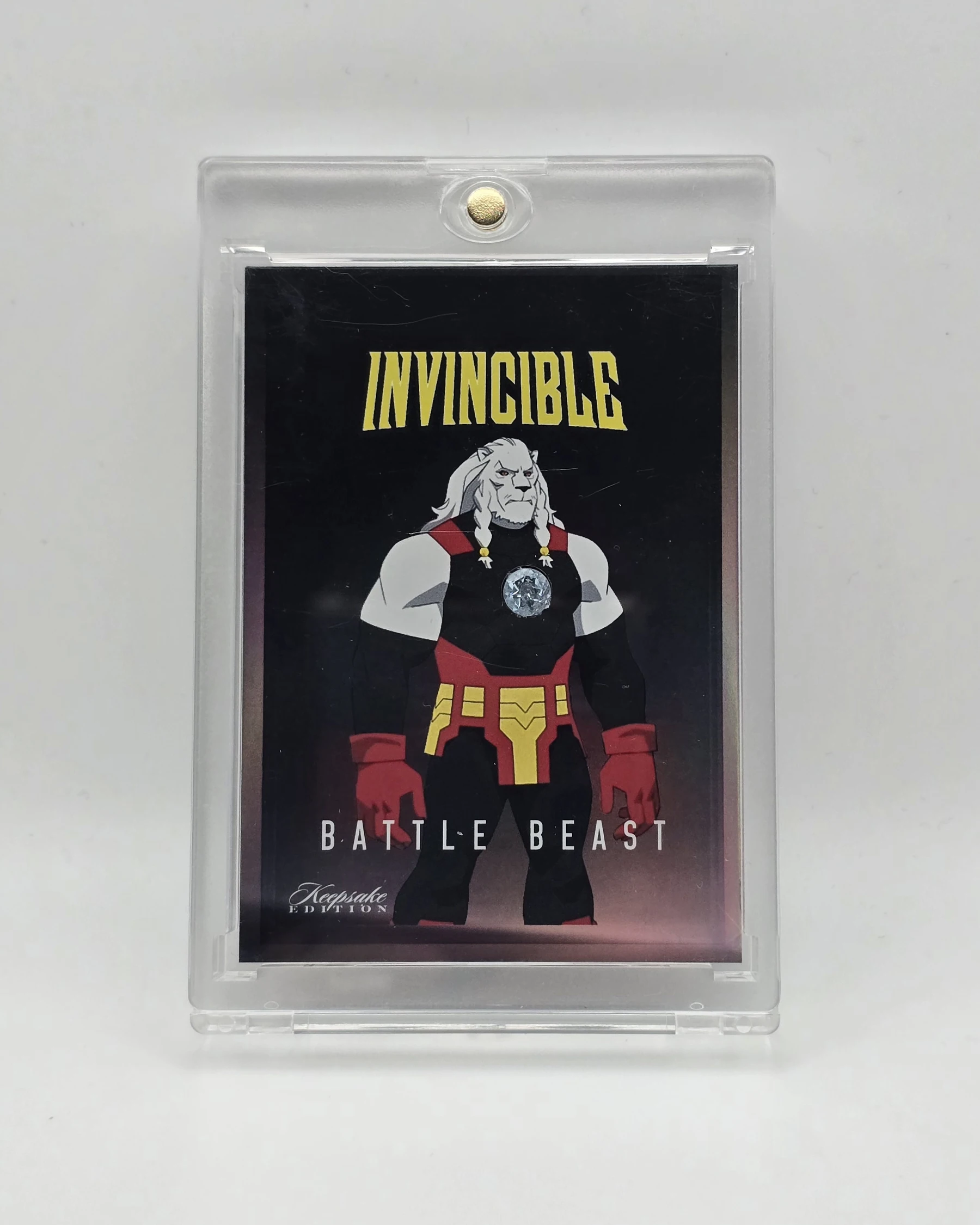
#299 · Battle Beast Power Gem Stone card.
Examine this item ↗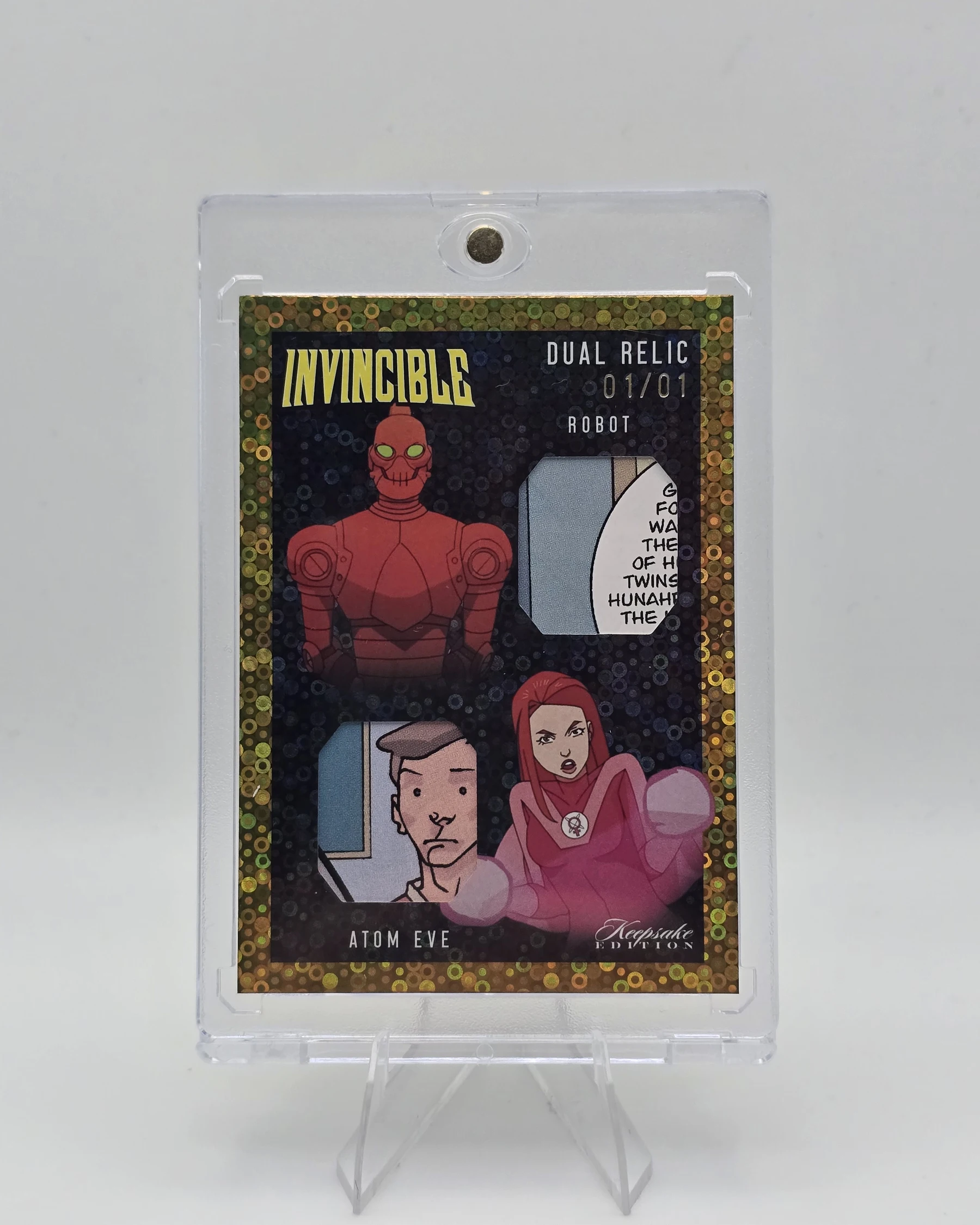
#523 · Robot and Atom Eve Authentic Dual Relic.
Examine this item ↗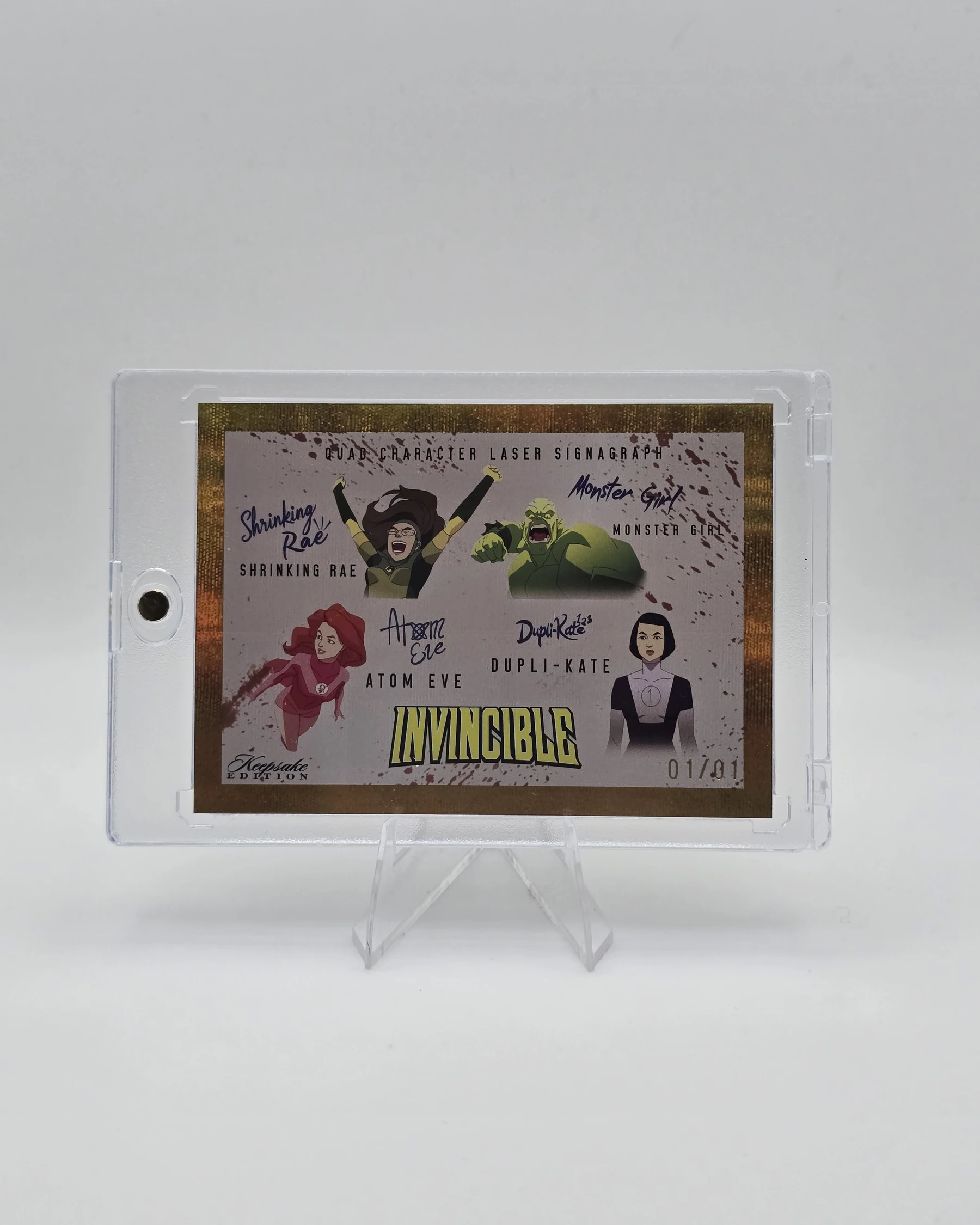
#436 · four-character Laser SignaGraph on the checklist.
Examine this item ↗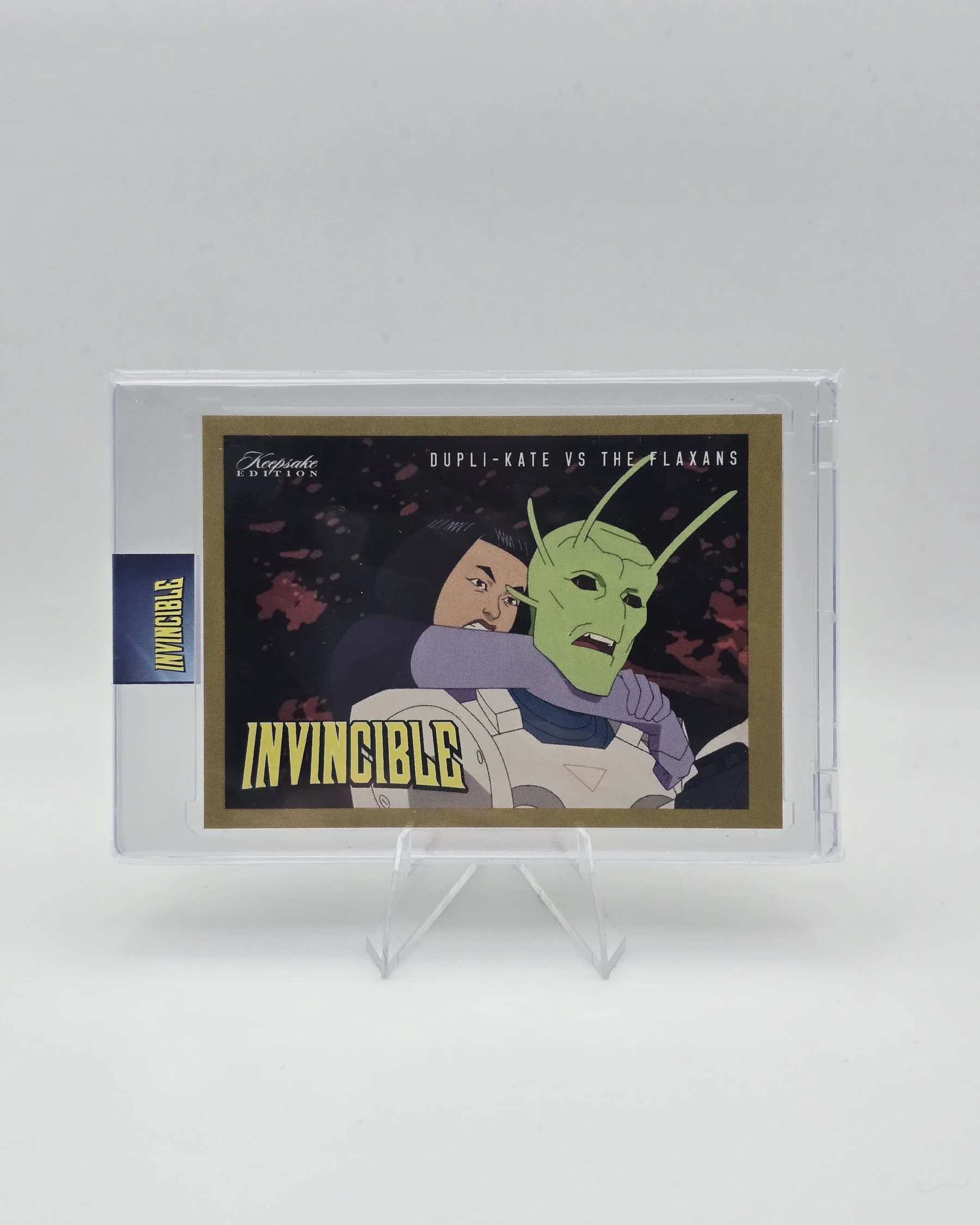
#289 · Dupli-Kate vs The Flaxans Kill Splatter subset.
Examine this item ↗A parallel is one version of a particular card
Collectors use 'parallel' for a related version of an underlying card, often with a different foil colour, finish, border or numbered run. You need the underlying design and the named release to identify it. A gold-looking card, a Gold /10 from Battle Beast Spotlight and a Gold /10 from Invincible VS are not interchangeable versions of one universal gold set. Their artwork, underlying checklist and product rules differ.
Start with a comparison of the same design in the same release. Note what changed—colour, finish, printed name or stamped serial—and compare the front and reverse. Avoid assigning a variant from colour alone: lighting, a sleeve or a camera can alter how foil looks. A manufacturer's checklist may define parallel names more precisely than a seller's shorthand. Until those details match, 'possible gold parallel' is a more accurate note than 'confirmed Gold /10'.
| Visible detail | What it can establish | What it cannot establish |
|---|---|---|
| Checklist #310 | A position in one named checklist | The serial run of this copy |
| 03/20 stamp | One copy in a stated /20 variant | The count of all character cards |
| 1/1 stamp | A single copy of that named variant | A single appearance of the character across all products |
Read the denominator, then the variant name
For a clearly marked /50 version, the denominator states a run of fifty copies for the version named on the card or checklist. /25, /10 and /1 indicate progressively smaller stated runs, but only within the same defined card identity. The numerator is that particular copy's position. An eBay title saying 'to 10' is not a substitute for a visible stamp or an official description that confirms exactly which card type receives that treatment.
A one-of-one is unique within the specified card design and variant. It is not necessarily the only card ever made of the subject, or the only unique card in the release. Several 1/1’s can depict Invincible with different images, finishes or insert names. Likewise, a box advertised as containing a card numbered '/25 or fewer' describes an upper limit: its outcome could be /25 or a lower numbered tier if the box wording permits. It does not promise the buyer exactly a /25.
Battle Beast supplies a clear six-tier example
Keepsake names six serial-numbering rarities in its Battle Beast 1st Edition Spotlight product: Blood Splatter /50, Orange /25, Blue /20, Red /15, Gold /10 and Black /1. The listing says each box contains one encased Battle Beast card numbered to /50 or fewer, then separately describes other card types and chase inserts. Its six-tier colour list is a rule for this product description; do not apply it automatically to Holo, VS or convention boxes.
A 03/20 Blue Battle Beast and a 03/20 card in a different product share a denominator, not an identity. Ask for the full card and reverse to check the parallel treatment, then compare the seller's wording with Keepsake's page. The archive contains /50, /25, /20, /15 and /10 Battle Beast records as well as other card types. Those holdings are examples, not a proof that every possible design or serial number has been photographed here.
| Named treatment | Published maximum for that tier |
|---|---|
| Blood Splatter | /50 |
| Orange | /25 |
| Blue | /20 |
| Red | /15 |
| Gold | /10 |
| Black | 1/1 |
Colour names do not travel unchanged between sets
The Invincible VS Collector's Box page describes a game-inspired health-bar scheme for base cards. It lists Blue /99, Yellow /50, Orange /25, Red /10, Gold /10 and Black 1/1. Notice that both Red and Gold are /10 in that base list, while Battle Beast Spotlight lists Red /15 and Gold /10. Even a familiar colour name can lead to the wrong scarcity claim if the release is missing from a listing.
Keepsake separately lists VS insert, SignaGraph and relic parallels with /99, /50, /25, /10 and 1/1 tiers, and narrower ranges for some special inserts. This is why a sentence such as 'all VS cards have six health-bar colours' would be inaccurate. Use the section of the manufacturer description that matches the type of card in front of you. A base card, a SignaGraph and a SignaPatch can have different parallel rules in the same release.
Short prints and odds are separate from serials
A short print is a less common card or variation, but an unnumbered short print does not disclose a precise print run. A card advertised as 'rare' or 'SSP' needs the exact official category and evidence; it cannot be turned into a made-up /10 merely because few copies are seen online. Likewise, a case-average chase rate describes distribution across many boxes, not a guarantee for the next box you open.
Keepsake's Holo Breaker description makes this distinction explicit: it lists two hits per box while describing several other possible finds as per-case averages and warning that those case hits are not guaranteed in any specific box. The VS listing has an Ultimate Move SSP category with specified /10 and 1/1 variations. In that case the official page supplies the denominator. In all other cases, keep the broad 'short print' label separate from a particular serial cap until the evidence supports both.
Verify the object in the photograph
For a higher-value parallel, request an image showing every edge and corner, the entire reverse, the serial stamp in focus and any signature or relic detail claimed in the listing. Ask whether the photographed copy is the exact one being offered. You can inspect surface scratches, print lines, whitening and centering from good photographs, although photos alone cannot settle a professional grade or guarantee authenticity. Keep the original full-frame image as a record; a tight crop can conceal the border and the space around the card.
Do not use a sealed-box photo to claim a particular numbered card. The manufacturer's odds and the box's stated tier describe possibilities, while an opened single has an observable card identity. When you encounter a 1/1 or a rare SignaGraph, compare its release, checklist and printed treatment with the relevant primary source. If the manufacturer has not published a detailed checklist for that format, label the unverified point as such and ask the seller for provenance rather than filling the gap with a guess.
Keep a one-line identity for every card
A reliable catalog entry reads: release; product or format; checklist number or insert title; character or characters; parallel name; visible serial; condition; front and back photo links; source. Put 'unknown' where the packaging, card or manufacturer has not established a fact. This structure makes it possible to compare two similar listings without merging different /10 variants into one row or counting a dual-character card as two checklist positions.
From there you can make a character checklist or a parallel rainbow with clear rules. Decide whether it must use one release, one card design, every officially listed colour, or only versions you have personally seen. You do not need to own a rare card to learn its identity. The next guide compares the manufacturer-confirmed parallels by release and explains what to look for when chasing a complete run.
Sources and checklists
Check manufacturer pages and official references for the current product details. Inventory and condition are confirmed for a specific item before purchase.
- Keepsake: Battle Beast Spotlight's named /50 to 1/1 variants ↗
- Keepsake: Invincible VS checklist and health-bar parallels ↗
- Keepsake: Season 2 Premiere checklist ranges and parallel colours ↗
- Keepsake: Season 1 Holo Breaker box and case-average hits ↗
- Keepsake: Season 1 Premiere product and official checklist ↗