PUBLISHED · UPDATED · GUIDE 14 OF 18
Compare exact designs, not only denominators
These photographed Battle Beast cards come from distinct designs. They do not form two steps of one rainbow.
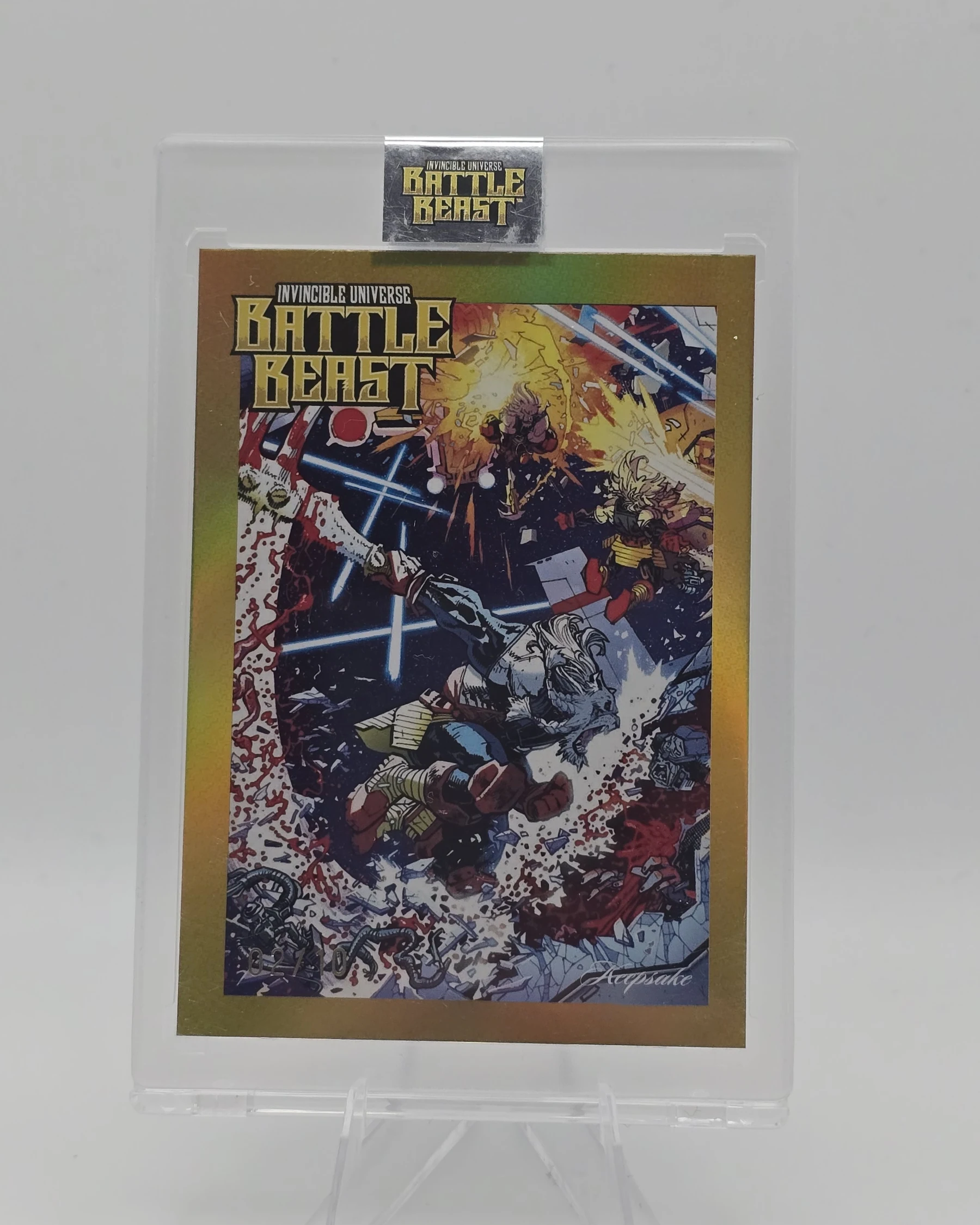
Photographed comic-design example.
Examine this item ↗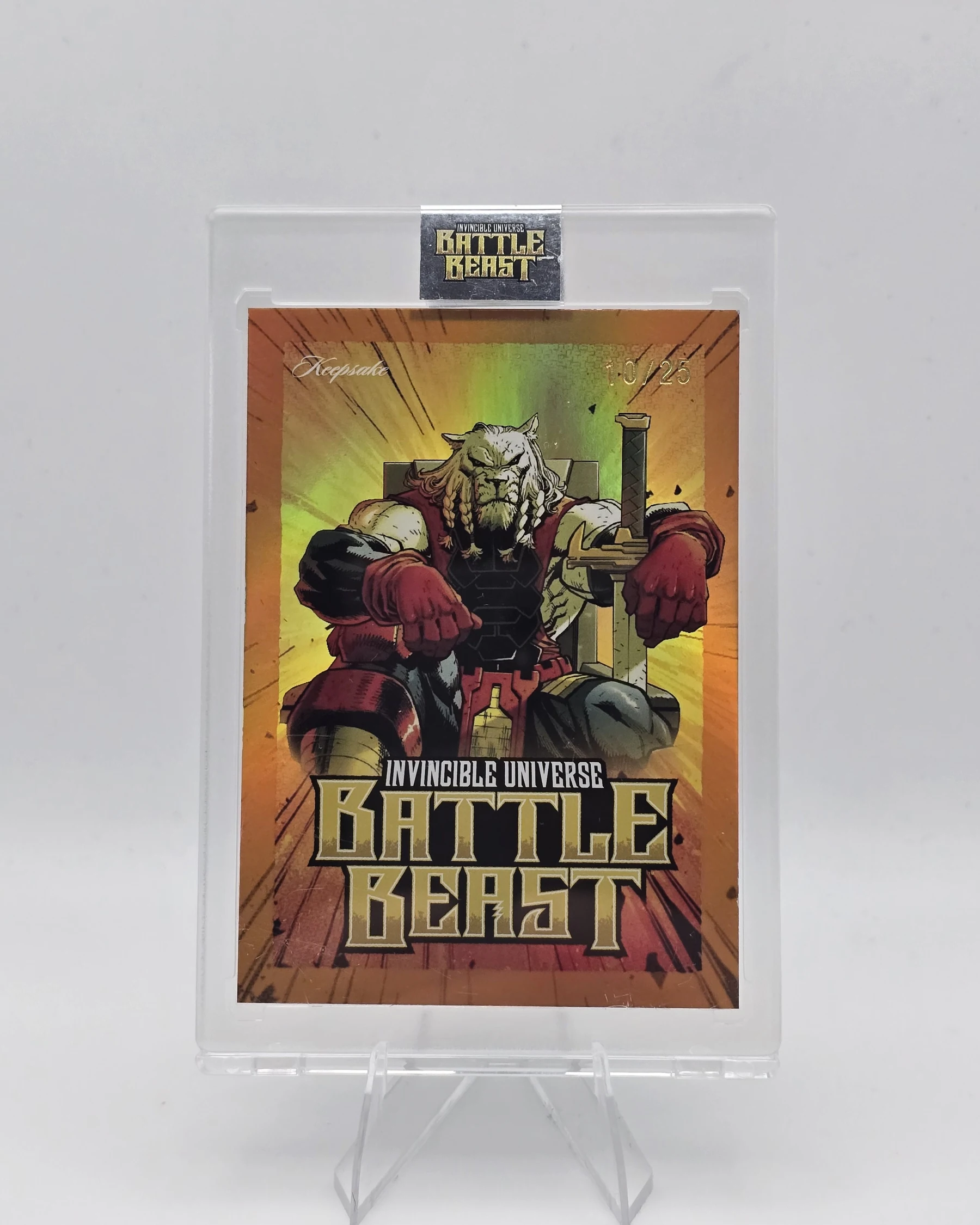
A separate photographed /25 design.
Examine this item ↗Know the one-card Spotlight format
Keepsake describes the Battle Beast 1st Edition Spotlight Series as one encased Battle Beast card per box, serial-numbered to 50 or less. That format is distinct from a four-card pack, a Season 1 Holo box, and a Season 2 convention mystery box. The box may reveal a base design, insert, SignaGraph, SignaPatch or another listed card type. Those categories describe the card; the serial-number tier tells you the stated edition size of the particular variation.
A standalone character release still can contain a variety of designs and multi-character SignaGraphs. Focus on the exact wording printed on the card and its reverse rather than assuming every Battle Beast product follows this ladder. Keepsake separately sells Season 1 Holo formats and a game-based Invincible VS set with different parallel structures. When searching a marketplace, include 'Spotlight Series' and the card number, not simply 'Battle Beast gold.'
The six serial-number tiers published by Keepsake
The manufacturer's Battle Beast Spotlight product page names six parallel tiers. The denominator is the maximum stated edition for an individual design and parallel, not the number of distinct artworks in the release. For a specific card, a legible 4/10 means copy four in the ten-copy variation. A Black 1/1 denotes one copy of its particular variation; the product may still have other distinct 1/1 designs.
| Parallel | Printed edition | Practical reading |
|---|---|---|
| Blood Splatter | /50 | Up to 50 of that specific card variation |
| Orange | /25 | Up to 25 of that specific card variation |
| Blue | /20 | Up to 20 of that specific card variation |
| Red | /15 | Up to 15 of that specific card variation |
| Gold | /10 | Up to 10 of that specific card variation |
| Black | 1/1 | One of that specific card variation |
The foil name alone never proves the card's identity
Color is only one piece of a Battle Beast listing. Record its checklist or insert number, artwork, character combination, card type, foil description and the actual numbered stamp. A 'Gold /10' base, a Gold SignaGraph and a Gold comic relic could be different cards with different demand and visual characteristics. A retail image of another copy can show the design, but it cannot show the exact serial number or condition of the copy you might buy.
Start with clear photographs of the front and back. Inspect print defects, card edge and corner condition through the factory case, check the manufacturer sticker and look for a readable serial number. Do not remove an encased card merely to simplify photos. If the listing is only an archive record here, contact the collector for images of the specific copy rather than treating the illustrative card type or reference estimate as a firm sale offer.
Chase inserts have their own average odds
The same official product page lists a 3D/4D insert at one in every 100 boxes on average, a SignaPatch at one in 50, an Issue #1 SignaPatch at one in 150, and a Kill Splatter insert at one per case on average. It also mentions 1/1 cut signatures from creators Robert Kirkman and Ryan Ottley, without publishing a box-level rate for those cut signatures on that page. These are descriptive manufacturer averages, not guaranteed spacing between hits.
A 1-in-100 average does not mean that box 100 after your last hit must contain a 3D/4D card. It also does not let you calculate the probability of a specific Battle Beast image, character combination or parallel without the relevant checklist and total production. Likewise, the page's six basic parallel tiers should not be copied onto every SignaPatch subtype as though all inserts necessarily exist in all six colors.
SignaGraph, SignaPatch and creator cut signature are distinct labels
Keepsake lists single, dual, triple and quad SignaGraph card types for this release. It separately advertises SignaPatch relics tied to comic material and original 1/1 cut signatures from the creators. A SignaGraph's character-themed signature design should not be advertised as a personally hand-signed actor or creator autograph without specific evidence for that card. A SignaPatch denotes the manufacturer's named relic-card category; the exact comic issue or material should be read from its particular card.
For advanced collecting, make a two-axis spreadsheet: one column for card family, another for parallel or serial tier. A quad character SignaGraph /10 is not interchangeable with a single-character base /10 just because the denominators match. Keep the names of every depicted or printed character, the number of subjects, the wording on the back and the edition numerator. That record makes comparisons across a broad Spotlight chase much more useful.
Build a rainbow one card design at a time
A rainbow is the set of color variations for one selected card design, not a pile of different cards featuring the same character. Choose a checklist number and artwork first. For that design, note which of the six advertised tiers are documented on the official checklist or photographed copies; then mark Blood Splatter, Orange, Blue, Red, Gold and Black as found, sought or unverified. If a particular insert has its own narrower print structure, use that structure instead of forcing the base ladder onto it.
Search by card number and image as well as parallel. Compare multiple photos to distinguish foil color under different light, and do not infer an edition from a sales title if the card's stamp is not visible. Set a budget for the tiers you genuinely enjoy, including the possibility that a specific 1/1 might be held indefinitely by another collector. A complete rainbow is a personal project; a missing Black variation does not diminish the cards you can document.
Compare an unopened box with a known single
The sealed Spotlight box gives you one encased numbered Battle Beast card at /50 or less, with the exact card unknown in advance. A photographed single lets you inspect its design, edition size and serial position before deciding. The former suits a collector who likes a surprise across the published hit categories; the latter suits a collector building a particular rainbow or seeking a particular comic relic. Neither purchase choice changes the manufacturer's published odds for the original box run.
When evaluating a sealed copy, request photos of all sides, seams and any factory seal. When evaluating a single, request front and back photos of the exact card inside its case and check for cracks, missing seals or obvious card movement. This site's archived Battle Beast entries are reference records unless a particular copy has been photographed and explicitly offered. Confirm actual availability and condition by inquiry.
Keep the release boundaries clear
Battle Beast appears across Invincible collecting, including other season-based cards. A photographed Season 1 Battle Beast foil 1/1 and a Spotlight Gold /10 are different designs; a loose card's opening box needs its own proof. The manufacturer also has an upcoming Season 2 Spotlight product with a broader cast and a stated /99-or-less box guarantee. A shared 'Spotlight' word does not transfer Battle Beast's /50, /25, /20, /15, /10, 1/1 ladder to the wider Season 2 product.
Use a precise listing title—year, Keepsake, product family, card name, card number and verified parallel—to help another collector find the right item. If you cannot establish the exact subtype, describe only what the photographs and card text show. The manufacturer page is the source for the ladder and stated average insert rates; your card's own front, back and serial stamp are the source for its identity.
Sources and checklists
Check manufacturer pages and official references for the current product details. Inventory and condition are confirmed for a specific item before purchase.